
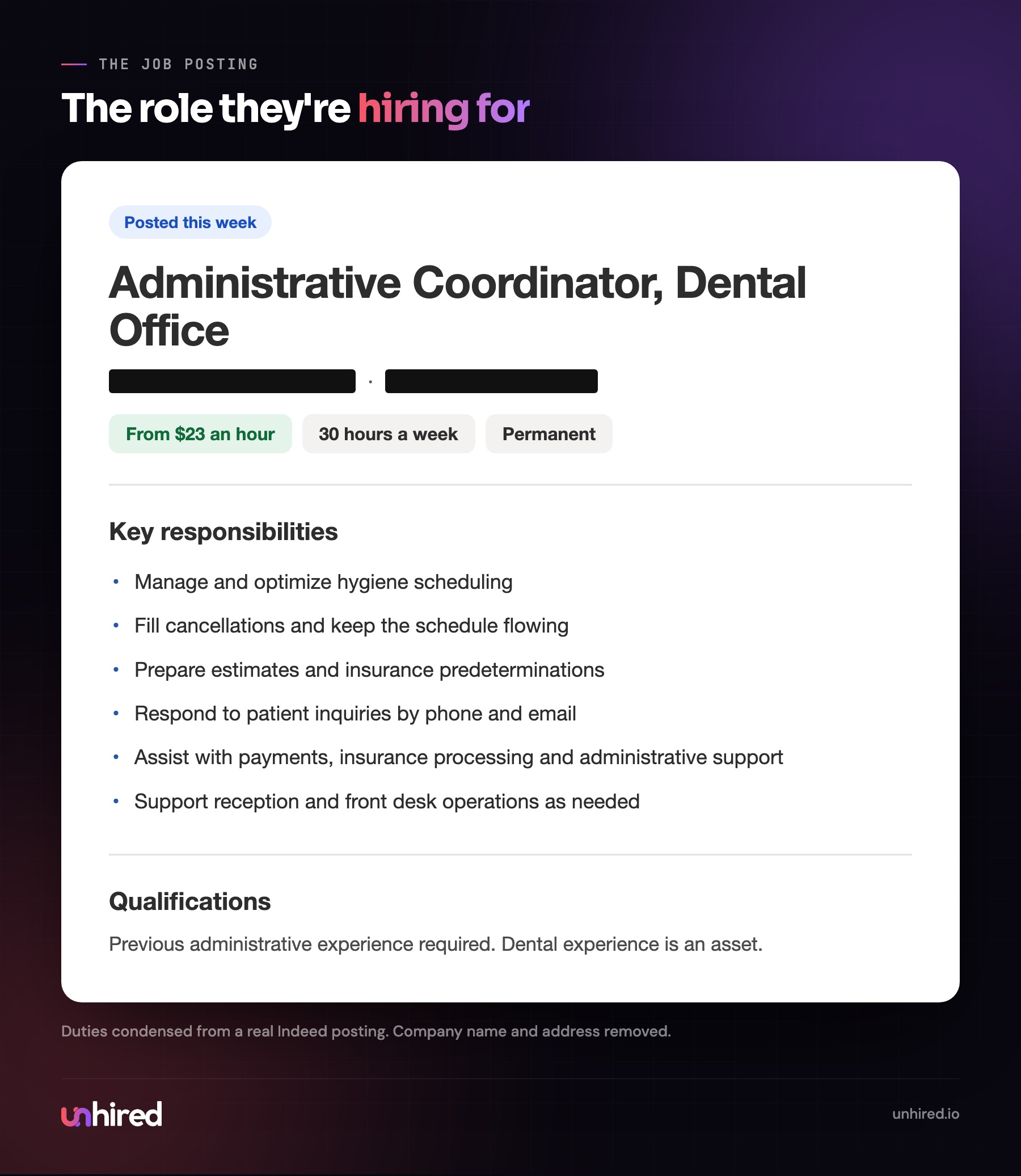
A dental office posted a job for an Administrative Coordinator this week. Thirty hours a week, permanent, starting at $23 an hour. The duty list is six lines long and starts with hygiene scheduling.
That first line tells you where the money in this job is. An empty hygiene chair at 2 pm on a Tuesday is lost revenue that never comes back, and most offices only find out about the gap when the patient doesn't show. The rest of the posting is the work that piles up around it: estimates, insurance predeterminations, phone and email, payments, and covering the front desk.
I read job postings the same way every time. I take each duty and ask whether it's coordination between systems or a call that needs a person. For this one, I'd hand most of the coordination to an AI Employee and keep a short, clear list of decisions with the team.
What I mean by an AI Employee
An AI Employee is AI built to hold one job on a team. This one would be the office's Administrative Coordinator: it reports to the office manager, has logins to the practice management software, the inbox and the phone line, and works from written rules about what it can do alone and what it has to bring to a person. Every message it sends and every change it makes goes into a log someone can read.
A booking widget on the website waits for a patient to click. This would work the recall list, the cancellations and the insurance queue all day, the way the person in the seat would. The longer explanation is here: What is an AI Employee?
Going down the posting
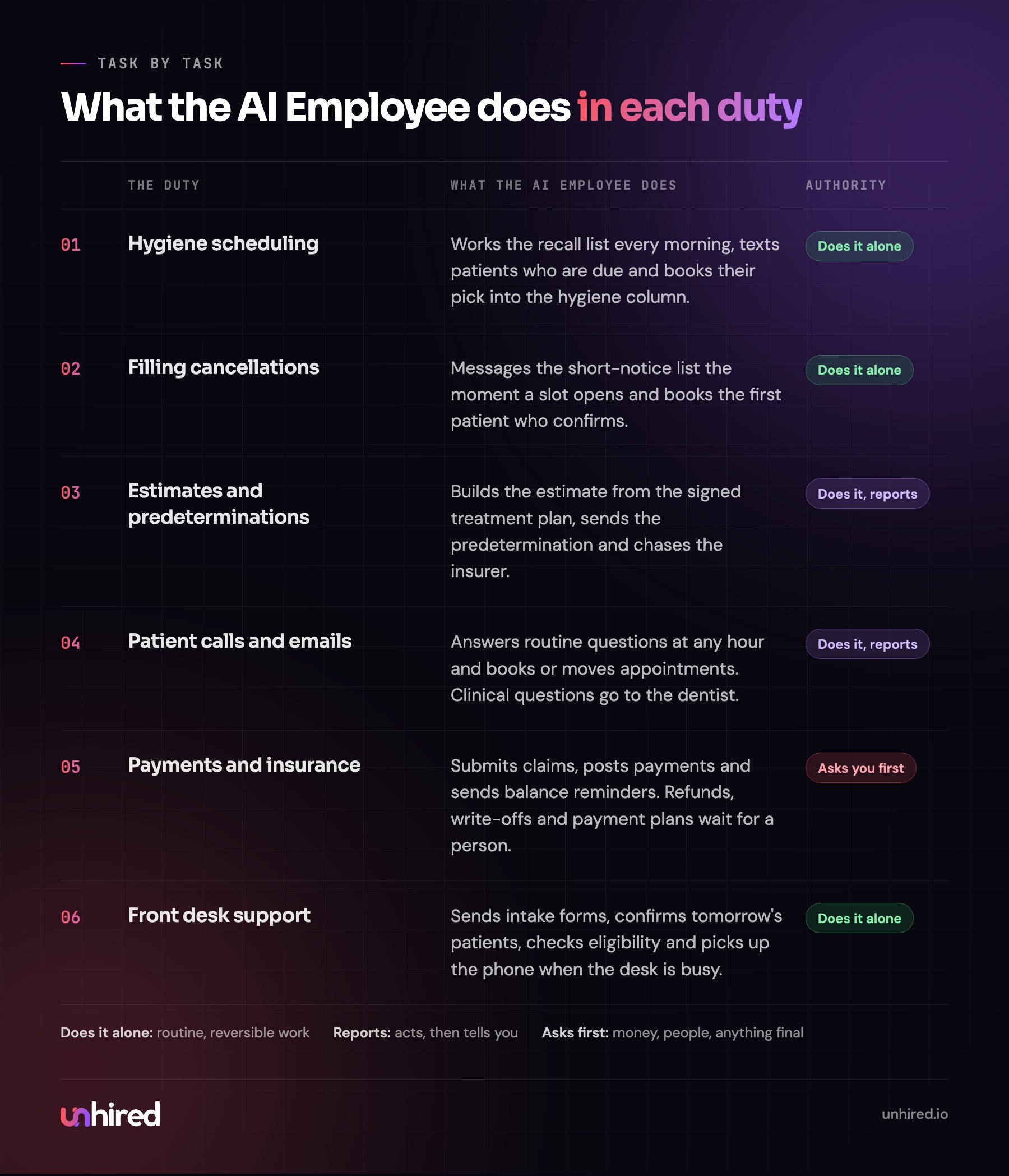
I'd split the six duties like this. The authority level next to each one matters as much as the work itself.
Hygiene scheduling
Every patient on a six-month recall has a due date sitting in the practice management software. In most offices someone works that list when the phones are quiet, which means it rarely gets worked. The AI Employee would go through the list every morning, text and email each patient who is due with a few open times, and book the one they pick straight into the hygiene column.
It would also watch the shape of the schedule. If a hygienist has three new-patient exams stacked on a Thursday afternoon, or a 90-minute scaling booked into a 60-minute slot, it flags that before the day arrives. Booking routine recalls it does alone. Rearranging a hygienist's whole day goes to the office manager.
Filling cancellations
A cancellation at 7:30 am for a 10 am cleaning is the hardest kind to fill, because the person who can fill it has to be reached in the next hour. The AI Employee would keep a short-notice list of patients who said they can come in on short notice, message them the moment a slot opens, and give it to the first one who confirms. It updates the schedule and tells the hygienist who is coming in.
This one it does alone. A booked slot is easy to undo, and an empty chair costs more than a wrong guess.
Estimates and insurance predeterminations
When the dentist writes up a treatment plan for a crown or a bridge, someone has to turn it into an estimate the patient can understand and, for larger work, send a predetermination to the insurer before anyone books the appointment. Then someone has to follow up when the answer doesn't come back.
The AI Employee would build the estimate from the treatment plan and the office's fee guide, send the predetermination through the claims network the office already uses, and chase the insurer on a schedule. When the answer arrives it updates the estimate and sends the patient their share. It reports each one to the front desk, because a patient will make a decision based on that number. Anything the dentist hasn't signed off on in the treatment plan, it leaves alone.
Patient calls and emails
Most of the calls to a dental office are the same dozen questions: can I move my appointment, do you take my insurance, how much is a cleaning, is the office open Friday, I lost my filling, what do I do. The AI Employee would answer the routine ones by phone and email at any hour and book or move appointments as it goes.
A patient describing pain, swelling or bleeding is a clinical question. The AI Employee takes the details, offers the next emergency slot the office keeps open, and passes it to the dentist or hygienist on duty. It doesn't give dental advice.
Payments and insurance processing
It would submit claims after each visit, post the insurance payments when they arrive, and send balance reminders with a payment link. Matching a payment to the right patient and the right claim is careful, repetitive work, which is the kind it does well.
Money that leaves the office or doesn't come in is a different matter. Refunds, write-offs, discounts and payment plans go to a person to approve, every time. That rule should be the same in any office.
Covering the front desk
The AI Employee can't hand a patient a clipboard. What it can do is keep the desk clear: send the intake forms before a new patient arrives, confirm tomorrow's appointments, check insurance eligibility the day before, and answer the phone when the people at the desk are busy with someone in front of them. The person checking patients in has fewer things to juggle while they do it.
A Tuesday, start to finish
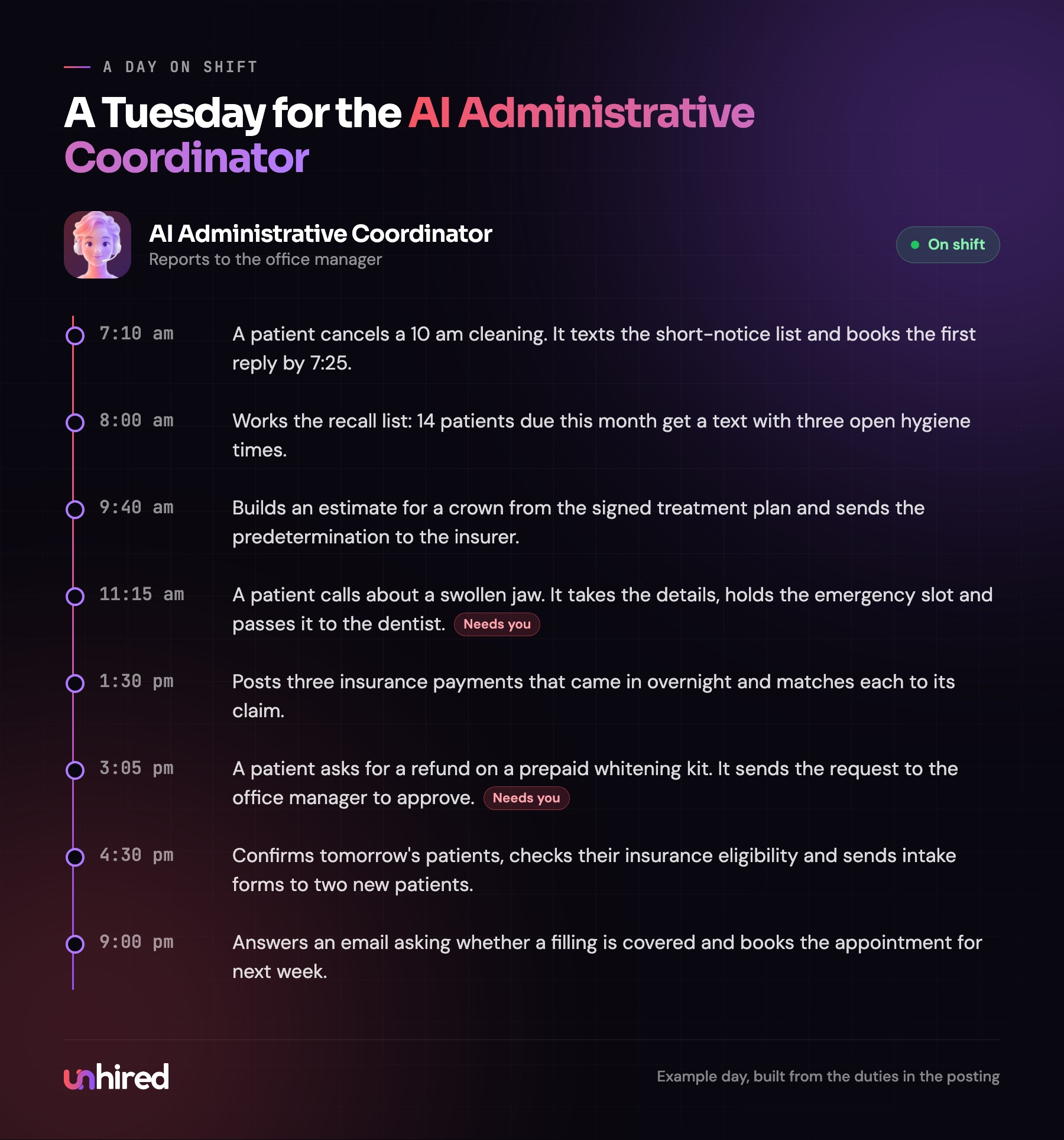
Two items on that day end up with a person: a refund request and a patient with a swollen jaw. Everything else gets done and logged without anyone stopping what they're doing. On a 30-hour posting, the work outside those hours is the part I'd look at first. The 7:10 am cancellation and the 9 pm insurance question would wait until morning today.
How an AI Administrative Coordinator is set up
The setup is mostly the same work as training a new coordinator. Someone sits with whoever runs the desk now and writes down how this office actually does things: how long each appointment type takes, which patients go on the short-notice list, which insurers need a predetermination for what, and what the office says when someone calls about a bill.
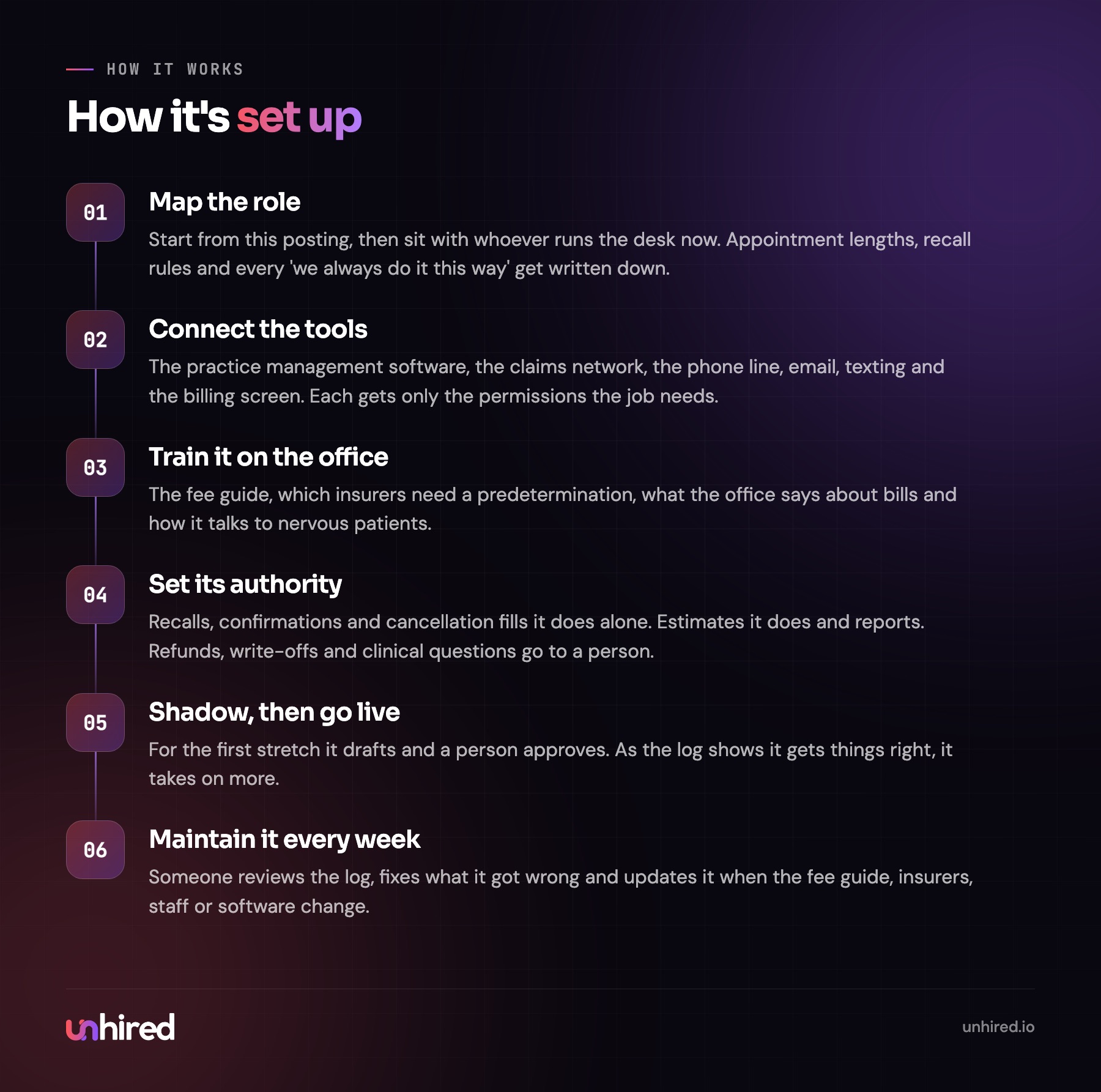
Two steps take longer than owners expect. The first is permissions. Patient health information is sensitive, so each connection should give the AI Employee only what the job needs and keep records inside the systems the office already uses. The second is upkeep. Fee guides change every year, and a new hygienist means new appointment lengths. Whoever sets it up, the office needs a named person or provider who reviews the log each week and keeps the instructions current.
What the seat costs a person
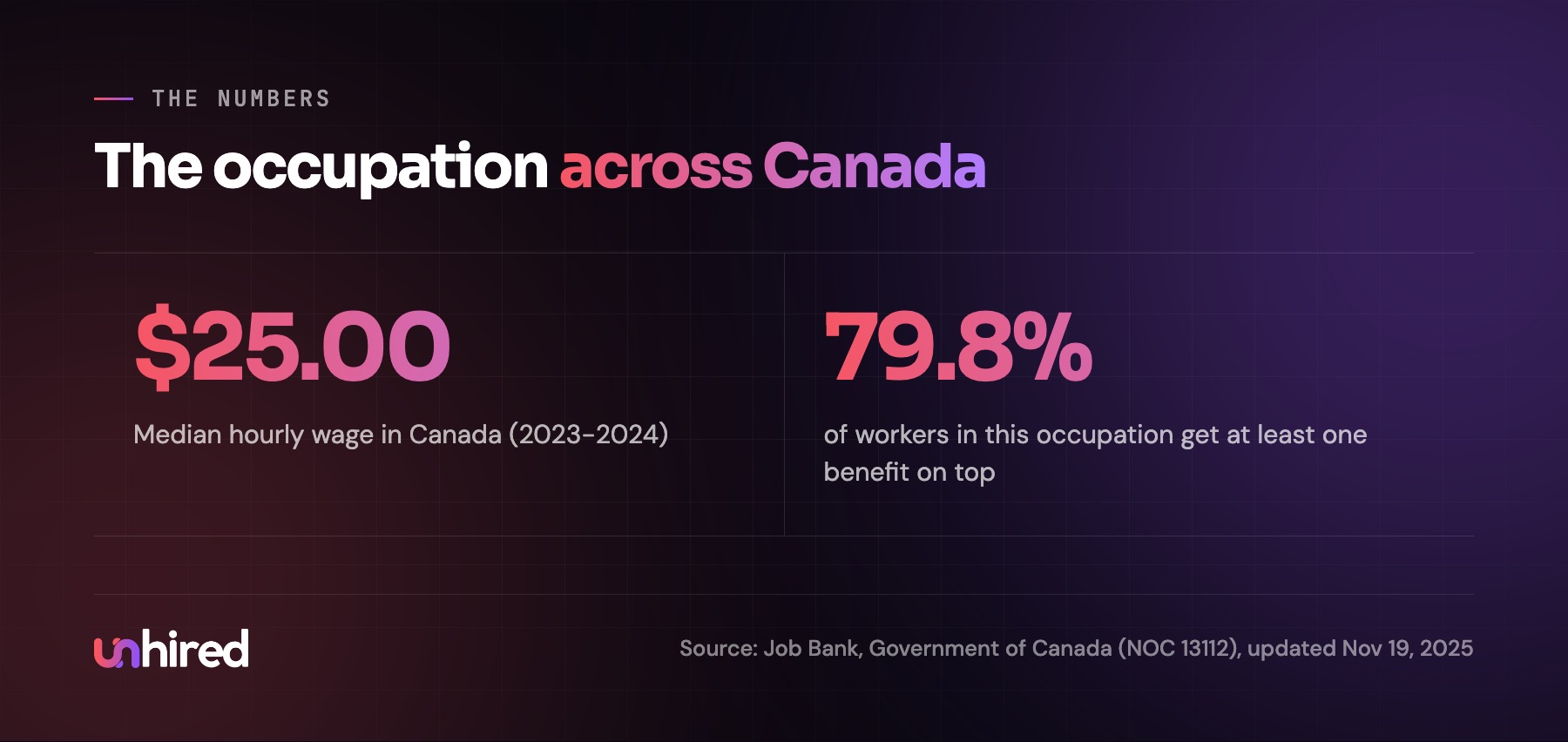
Job Bank puts the national median wage for medical administrative assistants (NOC 13112), the occupation dental admin postings usually fall under, at $25.00 an hour, based on 2023-2024 data. Full-time over 2,080 hours, that's about $52,000 a year. At the 30 hours this posting asks for, it's about $39,000. The posting's own starting rate of $23 works out to about $35,880 at 30 hours.
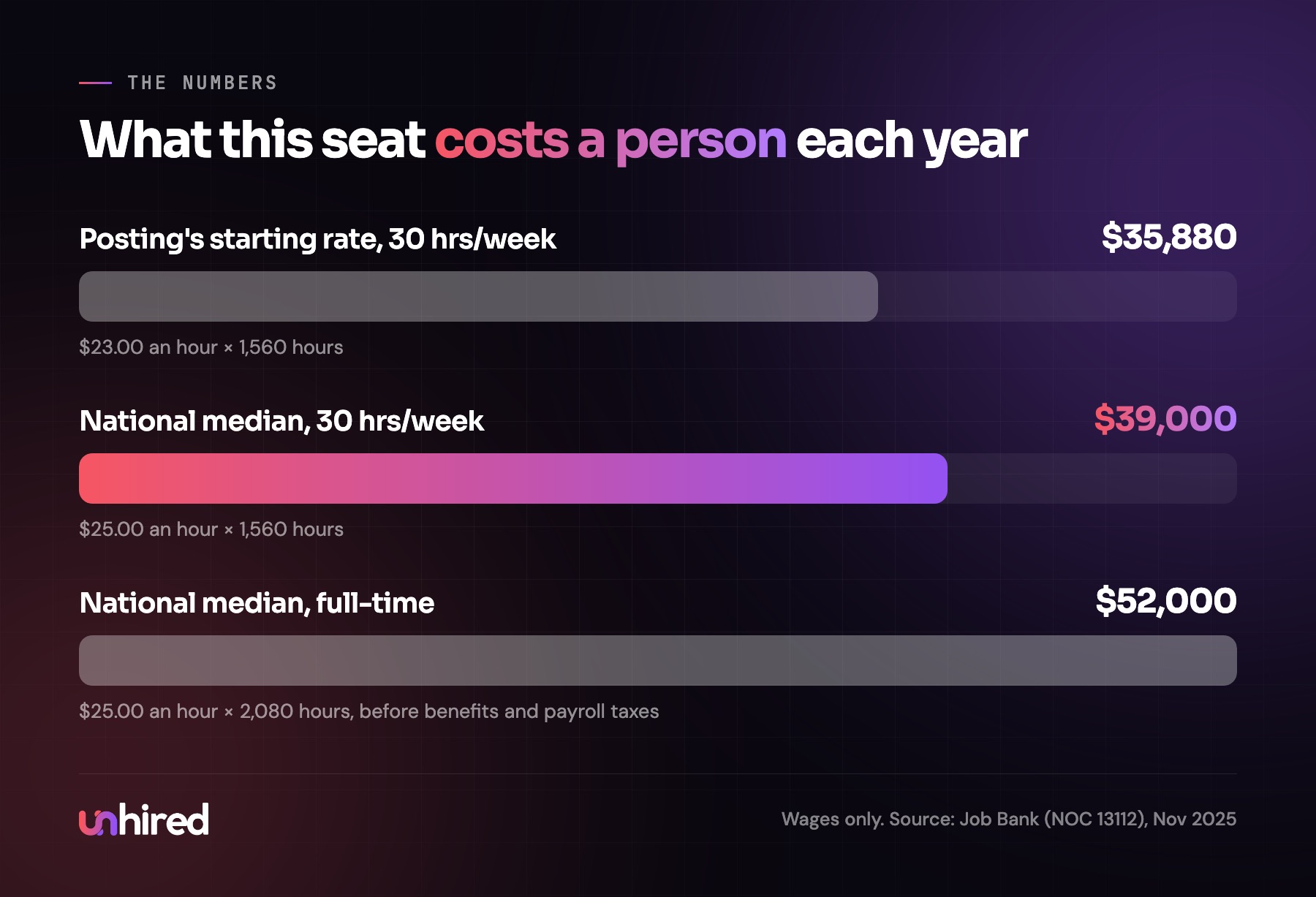
The wage is only part of the cost. Across Canada, 79.8% of workers in this occupation get at least one non-wage benefit on top of pay, and the employer also covers payroll taxes, vacation coverage, recruiting and the weeks it takes a new coordinator to learn the office's software and insurers.
How much you'd pay for an AI Administrative Coordinator
There are two ways to get one. An office can assemble it from software: an AI agent platform, a phone and texting tool, and connections to the practice management software and claims network, with someone on staff who builds and maintains it. Or it can have a provider build and maintain it, which is usually a monthly fee.
The price mostly depends on how many systems it connects to, how many calls and messages it handles in a month, whether it answers the phone by voice or only text and email, and how much ongoing maintenance is included. A one-dentist office with two hygienists needs much less than a group practice with four locations.
Whatever the quote, compare it against the whole seat: the wage at the hours you'd actually staff, plus benefits, payroll taxes and the cost of hiring and training. Ask what's included when the fee guide changes or you switch software, because that's where cheap setups fall apart.
Should this office still hire someone?
I'd split it. This office needs a person at the desk to greet patients and sit with a nervous first-timer. I'd keep that person and give the AI Employee the recall list, the cancellation fills, the predetermination chasing and the after-hours phone and email. Those are the parts of the job that get dropped when the desk is busy, and they're where the lost revenue is.
If you're about to post a job like this one, go down your own duty list before you publish it. Mark each line as either moving information between systems or a decision about money, health or a patient's trust. AI Employee assessments, such as the one offered by Unhired, can be a good place to start if you'd like a second read on where your role falls.
Wage data: Job Bank, Government of Canada, NOC 13112, updated November 19, 2025. The posting is real; the company name and address have been removed. The Tuesday schedule is an example built from the duties in the posting.